En Afrique noire, particulièrement au Sud-Bénin, « les morts ne sont jamais morts ».Les défunts sont honorés et représentés par des objets en métal (fer ou laiton) sortes d’autels portatifs, en forme de parasol dénommés ASSIN. C’est devant ces ASSINS que chaque membre de la famille viendra se recueillir pour rentrer en communion avec les mânes des ancêtres aux fins de demander bénédiction et protection. A cet effet, une cérémonie annuelle leur est consacrée. Elle est nommée DEXIXO NU ASSIN (Prière et offrande aux ASSINS) et se passe en cinq phases importantes que sont : In what is called black Africa, especially in southern Benin, it is often said that `the dead are not dead’. The dead are honored and represented by iron or brass objects in the shape of parasols. They are called ASSINS and serve as a sort of portable altar for the dead. Each member of the family must come to meditate and commune with these representatives of the souls of the ancestors in order to be blessed and protected by them. Thus there is an annual ceremony consecrated to the souls of the ancestors. It is called DELIXO NU ASSIN (prayers and offering to the `ASSINS) and takes place in five significant phases as follows:
-DE GBAN ASSIN TON : Présentation des offrandes aux sages et notables de la famille et raisons du sacrifice. Presentation of offerings to the wise elders and authority figures within the family and explanation of the reasons for the sacrifice.
Le conseil des anciens de la famille ainsi réuni agrée les offrandes destinées aux ASSINS et écoute religieusement les motifs pour lesquels l’offrande sera exécutée Le conseil des anciens demande alors aux TANNYNON (grandes tantes âgées ménopausées seules habiletés à ce culte), d’aller présenter les offrandes aux ASSINS dans le ASSINHOME (Case aux ancêtres qui est une sorte de petit temple). The family’s Council of elders, having thus met, accepts the offerings destined for the ASSINS and listens carefully to the reasons for which the offering will be made. Then the Council of the Elders asks the TANNYNON (elderly women beyond child-bearing age, the only women allowed in the ceremony) to present the offerings to the ASSINS in the ASSINHOME (hut serving as the home of the ancestors, which serves as a kind of small temple).
DE XIXO (paroles des souhaits) (Words and Wishes)
Le DE XIXO est la cérémonie d’invocation aux esprits des morts à venir considérer les offrandes des vivants de la famille aux fins d’être protégés et bénis par eux. Les offrandes sont constituées d’eau, alcool, boisson sucrée, poivre de Guinée, noix de cola, coqs, poules moutons et mets d’haricot. En suite les TANNYNON consultent l’oracle par des noix de cola et demandent aux ancêtres s’ils ont accepté l’offrande. DE XIXO is the ceremony for invoking the spirits of the dead to come and examine the offerings that the living members of the family have given in order to be protected and blessed by these spirits. The offerings consist of water, alcohol, sweet non-alcoholic drinks, Guinea (hot) peppers, cola nuts. chickens, sheep and bean dishes. Next the TANNYNON, bearing cola nuts, consult the oracle to see if the spirits have accepted the offering.
NU HU HU (sacrifice)
Le NU HU HU est le rituel consacré à l’immolation des volailles et moutons dont le sang est versé sur les ASSINS. Avant de sacrifier les volailles, il est nécessaire de leur faire boire de l’eau et pour les moutons de leur faire manger certaines feuilles. En cas de refus, c’est le signe que les esprits des morts refusent la cérémonie. Il faudra alors reprendre et consulter le FA (systhème géomantique de divination) pour savoir les raisons de leurs refus. NU HU HU is the ritual devoted to the sacrifice of the fowl and sheep whose blood will be poured over the ASSINS. Fowls must be made to drink water and the sheep forced to eat special leaves before they are sacrificed. If they refuse to do this, it means the spirits of the dead have not accepted the ceremony. It is therefore necessary to consult the FA (a system of divination) to find out the reasons for the refusal.
GBE DI-DO (compte rendu oral) (oral report our)
Après le rituel précédant, les TANNYMON apportent le reste des offrandes et rendent compte au conseil des anciens de la manière dont les rituels se sont déroulés dans la case aux ASSINS. After the previous ritual the elderly women bring the leftover offerings to the Council of the Elders and report on the way the rituals were carried out in the temple of the ASSINS.
NU HEN HLEN (Offrande des mets de choix)
C’est la dernière phase de la cérémonie. Elle se passe totalement le soir au couché du soleil. Elle consiste à donner aux ASSINS les morceaux de viande très précis (Tête, pattes , cœur, gésier, le foie) Les ancêtres étant servis les participants peuvent alors manger le reste en un repas de communion fraternel et convivial. This is the last phase of the ceremony. It takes place only after sunset. It consists of giving the ASSINS certain specific pieces of meat (the head, a leg, the heart, the gizzard, the liver). After the ancestors have been served, the participants can join in a convivial and brotherly meal.
Cette cérémonie a été réalisée au temple des ASSINS de la famille HOUNDJE dans la commune de Ouidah au Bénin. This ceremony was performed in the Houndje family’s temple of the ASSINS in Ouidah, Benin.
Showing posts with label ceremony. Show all posts
Showing posts with label ceremony. Show all posts
Friday, September 23, 2011


Saturday, August 20, 2011
#1 - Le Vodun
Le Vodun est une ancienne religion présente dans la vie quotidienne des africains de l’ouest. A travers le culte des ancêtres, il est le lien entre l’esprit des morts (toujours présents parmi nous) et le monde des vivants. Religion des ancêtres éponymes, il s’exprime à travers les différents phénomènes naturels considérés en tant que force de la nature. Vodun is an ancient religion in the everyday life of west-Africans. By following the same religious practices as their ancestors, followers link the spirit of the dead (who are always among us) and the world of the living. A religion of named ancestors, it expresses itself through various natural phenomena and is considered to be the force giving power of nature.
Les Adeptes et les cérémonies Vodun Le Vodun possède une hiérarchie organisée. Il a son temple, ses adeptes, ses inities et ses servants. Les inities peuvent être des enfants comme des adultes, ils sont appelés « Vodunssi », après un passage de plusieurs mois dans un couvent et prêtent serment de ne pas témoigner des secrets enseignés ni d’abjurer leur foi en leur Vodun. Dans ce petit film, vous voyez différents vodunssi célébrant le culte de Vodun DOVO. Each Vodun is composed of a carefully planned hierarchy. It has its temple, its faithful, its initiates and its servants. Both children and adults can be initiated. They spend several months in the convent, after which they swear to keep secret the mysteries of Vudon and to always be faithful to their religion. At this point they are given the name, “Vodunssi.” In this video, you see several Vodunssi celebrating the cult of Vodun Dovo. 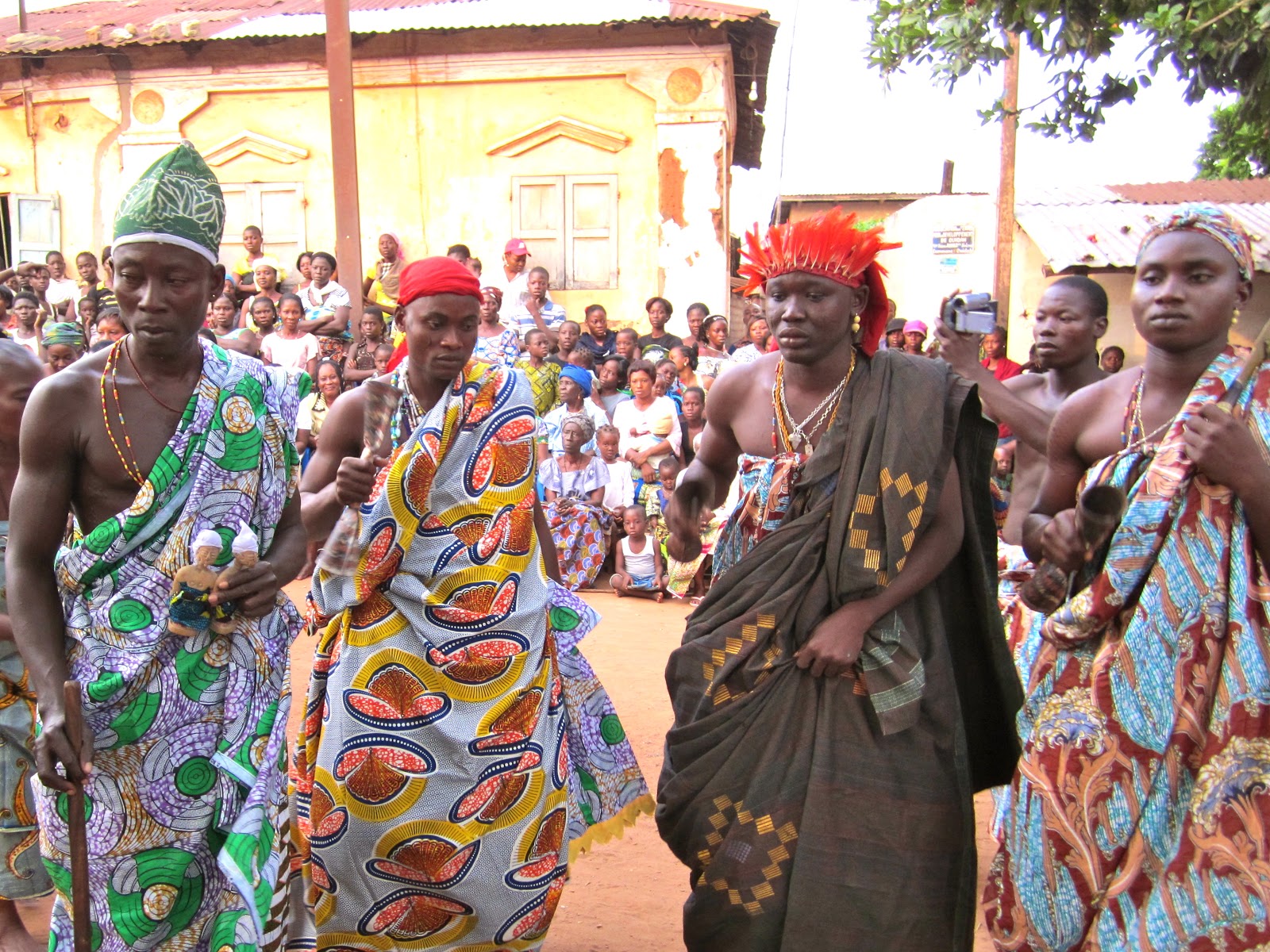 |
Le nouveau chef couvent avec les adeptes hommes – The new convent priest and his fellow followers. |
 |
Les femmes adeptes – Women followers |
Voyons la cérémonie de Vodun DOVO
Le Vodun DOVO est le dieu protecteur, dieu de défense et dieu des grands combats d’une partie de la communauté Fon d’Abomey installée à Ouidah autour des années 1750 après la conquête du royaume de Savi par le roi AGADJA d’Abomey vers les années 1727. Depuis des siècles, des générations se succèdent, vivifiant son culte, ses temples et sous le couvert d’un chef de couvent et du chef de famille. Ici, nous sommes dans l’aspect culturel, par ses danses et rythmes sacrés. C’est une musique codée, dont la percussion, les gongs, les chants, les accoutrements et les pas des danseurs signifient et répondent à une formule précise exigée par le Vodun DOVO. Vodun Dovo is the protector-god, god of defense, and the god of war that comes from the Fon community of Abomey. Its followers arrived in Ouidah around 1750 after the conquest of the kingdom of Savi by the Kind Agadja d’Abomey around 1727. Since that time, generations of faithful followed them, enlivening the cult and its temples, all under the leadership of the convent priest and the head of the family. Here, we experience its cultural manifestations in its sacred dance and rhythm. It is a coded music, in which the percussion, the bells, the songs, the clothing, and the steps of dancers all signify and respond to a formula precisely commanded by Vodun Dovo.
 |
Danse d’un adepte – A follower dancing |
Cérémonie de sortie de nouveaux adeptes de Vodun DOVO
Chaque Vodun dispose de son couvent, d’un chef couvent et ses collaborateurs du chef couvent. Voilà plus de 23ans que le chef couvent de Vodun DOVO et certains de ses collaborateurs étaient mort et depuis les postes étaient vacants. Les adeptes de Vodun DOVO et toute la population sont fiers de retrouver la réanimation culturelle de ce Vodun perdue il y a 23ans environs. La présente cérémonie est la fin d’une série d’initiation qui débouche sur l’installation d’un nouveau chef couvent. Every Vodun has its convent, its convent priest, and its assistants to the priest. It has been more than 23 years since the priest of Vodun Dovo died, and since then several other posts have also become vacant. The followers of Vodun Dovo and the community are excited to see this representation, lost for 23 years, present itself. This ceremony is at the end of a series of initiation ceremonies that ends with the installation of a new convent priest.
 |
Vodun Atchina Dovo |
Ce blog est une petite partie du Grand Vodun. Contactez-nous pour plus de connaissance sur le Vodun. This blog is a little piece of a big religion. Contact us for more information.
(229) 66 74 72 52
(229) 95 62 78 43 begin_of_the_skype_highlighting (229) 95 62 78 43 end_of_the_skype_highlighting
(229) 21 34 10 66 begin_of_the_skype_highlighting (229) 21 34 10 66 end_of_the_skype_highlighting
ciamobenin@gmail.com
(229) 95 62 78 43 begin_of_the_skype_highlighting (229) 95 62 78 43 end_of_the_skype_highlighting
(229) 21 34 10 66 begin_of_the_skype_highlighting (229) 21 34 10 66 end_of_the_skype_highlighting
ciamobenin@gmail.com
Vos dons soutiendront nos recherches et la promotion d’education artistique et culturelle au Benin. Your gifts support our research and the promotion of arts education and cultural education in Benin. Visit: http://www.crowdrise.com/ArtForceAfrica.
Subscribe to:
Posts (Atom)